
Stop Staring, Please
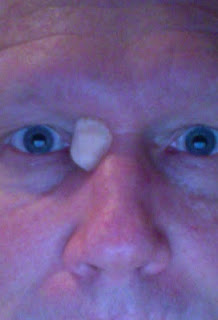 Two and a half weeks ago, my dermatologist performed a Moh’s surgery procedure on me to remove a patch of squamous cell skin cancer from the inside of the bridge of my nose. It really is more of a nuisance than a serious threat but the healing process has not been fun. It was painful at first and came with a swollen, partial black eye and an obnoxiously large bandage that blocked my vision. The big bandage took a week to get reduced to a large bandaid, and now I’m down to a small circular one that I almost forget is there … until I go out in public.
This whole ordeal has given me a new perspective, and not just on the issue of why we need to use sunscreen. I already knew that and have chosen to ignore it for most of my life. The bandage is a consequence of my bad choices and a reminder that I have made a lot of them. But the reason I’m writing this is because the bandage has also become a trigger for making me realize how badly most of us react to those who are different from us. It’s a realization that may even be uglier than squamous cell skin cancer.
It’s only a bandaid people!
Little kids stare at me like I have a third eye. Adults in the airport pretend not to look, but then I catch them stealing glances. It’s as if I had a giant growth sticking out of my forehead and it has made me think, “What if I did?”
What if, like the young man my wife and I saw in Times Square this week, instead of a two-week stint with a bandaid, I had a lifelong attachment to a giant growth that deformed my face and forehead? What if I had Down Syndrome? What if I had a speech impediment? In other words, what if I could never take the bandaid off? Do we even realize how much we can affect the personality of someone simply by staring at them because they are different?
I doubt it.
Though this is a good reminder about how we treat people who are different from us, it is obviously not some profound insight I got from having a bandaid stuck to my face. The real reason I’m writing this came last Sunday when, in the midst of my two-week bandaid ordeal, our minister addressed the subject of homosexuality and same-sex marriage in his sermon. I agreed with everything he said: That homosexuality is clearly condemned in the Bible; that same-sex “marriage” is an oxymoron; that we as a society should reject it; and that our reactions to the homosexual agenda are largely unproductive and makes things worse. All that said, it made me think, “What if your bandaid is homosexuality?”
I once flew with a flight attendant who commented that you could tell he was a homosexual “from outer space” … and he was right. How do we — how do I — treat people like that? Is my first reaction to stare; to mock … or to love?
Now, I know there are those who will argue with me about comparing the permanence and innateness of homosexuality with a bandaid that I can take off at will. I think there are good reasons to reject the idea that homosexuality is not a choice. I know there are good reasons to argue that homosexuality defies natural law and is therefore objectively immoral. I reject the very idea of same-sex “marriage.” I am not arguing those points here. I could be wrong about them but if I am my point becomes even more relevant.
Let’s assume I am right. Let’s assume that, like my squamous cell skin cancer, the bandaid we stare at is there because homosexuality is a cancer that comes as a consequence of immoral behavior. So what? My being right about homosexuality has nothing to do with my treating other people — most especially homosexuals — with love and kindness, even in my own private conversations about it.
I have been guilty of failing at that responsibility — that’s what my bandaid really taught me.
We need to love homosexuals more than they love homosexuality, whether it’s a bandaid they can take off or not.





Does love equate with tolerance?
I think the post answers that question pretty directly … but the answer relies heavily on how you define both love and tolerance. The culture defines love and "tolerance" as acceptance/agreement but nothing could be further from the truth. In order to tolerate someone who holds a different view from me I would have to disagree with them. So, on my view, tolerance on homosexuals comes precisely from the fact that I disagree with the claims of the homosexual community about the nature of both homosexuality and same-sex "marriage," yet I love homosexuals despite that disagreement.
Sometimes loving someone means that we tell them the truth about their destructive, immoral actions and persuade them to stop. It wouldn't be "loving" to let someone stand on the tracks when a train was heading their way, for instance. We should always be tolerant of persons, but never of bad ideas. Loving someone demands it.